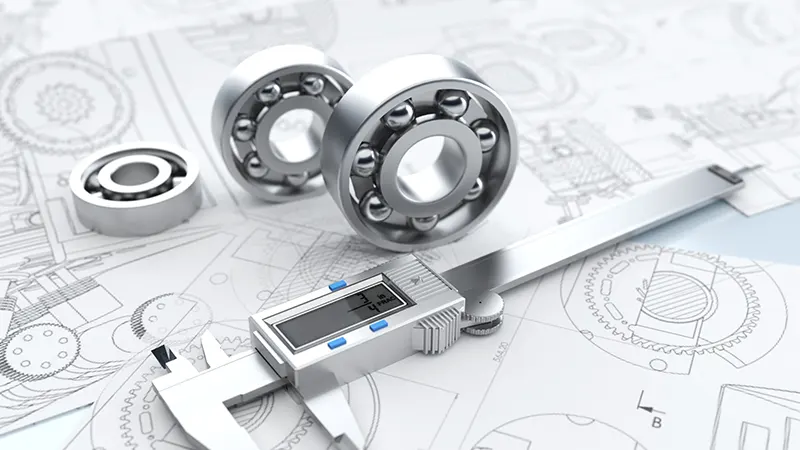
The selection of bearings directly determines the stability of equipment operation, service life, and maintenance costs. Choosing the right one or not is expensive, and adaptation is the core. Many faults stem from improper selection. By mastering the following practical tips, one can accurately avoid selection errors and make the bearings perfectly match the working conditions.
Prioritizing adaptation to working conditions is the core prerequisite. Priority should be given to selecting self-aligning roller bearings and tapered roller bearings for heavy-duty scenarios. These types of bearings have strong load-bearing capacity and can cope with composite loads; High speed equipment such as motors and precision machine tools should use deep groove ball bearings and angular contact ball bearings, which have low friction coefficients and high speed limits. In humid and corrosive environments, stainless steel materials or anti-corrosion bearings should be used, and the selection of sealing structures should be combined to prevent impurities from entering.
Accurately match installation and size parameters. It is necessary to strictly verify the dimensional accuracy and concentricity requirements of the shaft and bearing chamber to avoid bearing operation jamming caused by tight fit and impact vibration caused by loose fit. Select the corresponding structural bearings based on the size of the installation space. If the space is limited, thin bearings can be selected. When the axial load is large, thrust bearings need to be used in conjunction to ensure installation compatibility.
Select based on lubrication and maintenance requirements. Pre lubricated bearings can be used in closed and maintenance free scenarios to reduce maintenance costs in the later stages; High temperature and dust conditions require the use of bearings that are compatible with specialized lubricating oil, while considering bearing sealing performance to prevent lubrication failure. In addition, maintenance convenience should be taken into account, and bearing types with simple structures and easy disassembly and assembly should be prioritized to reduce maintenance difficulty.
Balancing cost-effectiveness and adaptability. There is no need to blindly pursue high-end bearings. Reasonably balance cost and performance while meeting the requirements of working conditions and service life. At the same time, pay attention to the interchangeability of bearings, choose models with strong universality, facilitate the replacement of spare parts in the later stage, and further reduce operation and maintenance costs.