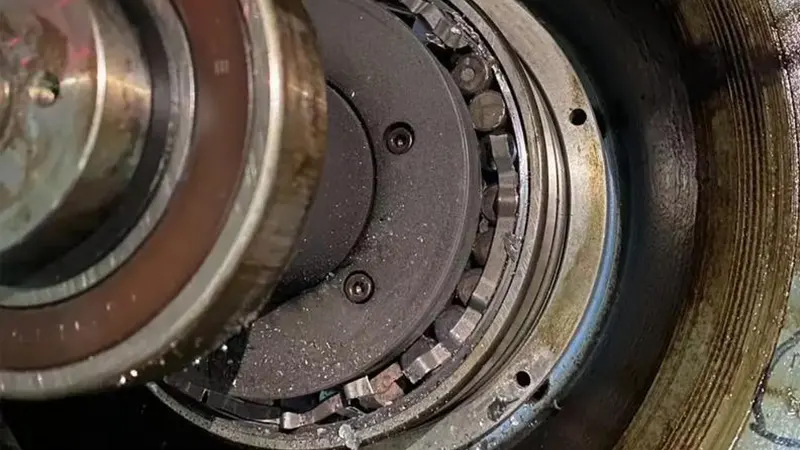
Bearing jamming is a common and serious fault during operation, often manifested as the inability of the bearing to rotate and the operation jamming. If not dealt with in a timely manner, it can easily cause equipment shutdown, component damage, and even expand the scope of the fault. The main causes are related to factors such as lubrication, installation, working conditions, and wear. Only by accurately identifying the cause can we efficiently investigate and avoid recurrence.
Lubrication failure is the primary factor leading to bearing jamming. Insufficient lubricating oil, improper selection, or deterioration of oil quality can prevent the formation of a stable oil film between the rolling elements and the inner and outer rings. Direct friction between the metal generates a large amount of heat, leading to contact surface strain, erosion, and ultimately adhesion and jamming; If impurities are mixed into the lubricating oil, it will also exacerbate abrasive wear, damage the raceway and rolling element structure, and cause jamming.
Improper installation can also easily lead to jamming faults. Uneven and skewed force during bearing pressing can cause deformation of the inner and outer rings, offset of the raceway, local stress concentration during operation, and accelerated wear and jamming; Excessive dimensional deviation and insufficient concentricity between the shaft and bearing chamber can cause severe friction during bearing operation, leading to jamming after heating up; In addition, residual iron filings and impurities mixed into the bearing during installation can also cause mechanical jamming.
Extreme working conditions and component losses cannot be ignored. Under heavy load and high-speed operation, excessive temperature rise of bearings can easily cause thermal expansion of parts, resulting in reduced clearance and card jamming; Damp and corrosive environments can cause bearing corrosion, resulting in rust and protrusions on the raceway and rolling elements, hindering rotation; After long-term use, the wear or breakage of rolling elements and retainers in bearings can directly cause jamming.
To avoid bearing jamming, it is necessary to do a good job of source control: choose lubricating oil that is suitable for the working conditions, regularly check the oil quality, and replace it in a timely manner; Standardize the installation process to ensure uniform force distribution, precise size, and clean installation environment; Reasonably control the load and speed according to the working conditions, do a good job in anti-corrosion and cooling protection, regularly inspect the bearing status, and detect and deal with hidden dangers early.