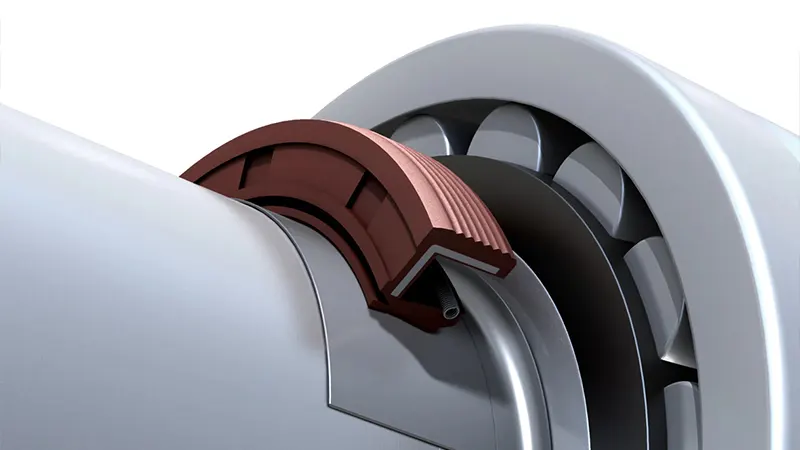
The tapered roller bearing developed on the basis of bearings works by replacing sliding friction with rolling friction. It is generally a highly universal, standardized, and serialized mechanical basic component composed of two rings, a set of rolling elements, and a cage. Due to the different working conditions of various machinery, different requirements have been put forward for bearings in terms of load capacity, structure, and performance. Therefore, bearings need to have various structures. However, the basic structure consists of an inner ring, an outer ring, rolling elements, and a cage.
1. Contact fatigue (fatigue wear) failure
Contact fatigue failure is one of the common failure modes of various tapered roller bearings, which is caused by the repeated action of cyclic contact stress on the bearing surface. The contact fatigue peeling on the surface of bearing parts is a process of fatigue crack initiation, propagation, and cracking. The initial contact fatigue crack first occurs at the point of high normal shear stress below the contact surface, and then extends to the surface to form pitting like peeling or flaky peeling, the former being called pitting corrosion or pitting peeling; The latter is called shallow peeling. If the initial crack occurs at the boundary between the hardened layer and the core, causing early peeling of the hardened layer, it is called hardened layer peeling.
2. Adhesion and abrasive wear failure
It is one of the common failure modes on various bearing surfaces. The relative sliding friction between bearing components causes continuous loss of surface metal, which is called sliding friction. Continuous wear will cause changes in the size and shape of the parts, increase the clearance between the tapered roller bearings, deteriorate the working surface morphology, thereby losing rotational accuracy and preventing the bearings from working properly. The forms of sliding wear can be divided into abrasive wear, adhesive wear, corrosive wear, micro motion wear, etc. Among them, the common ones are abrasive wear and adhesive wear.
The phenomenon of friction surface wear caused by external hard particles or metal grinding between the friction surfaces of tapered roller bearing parts belongs to abrasive wear.
For bearings, the inner ring usually fits tightly with the shaft and runs together with it, while the outer ring usually forms a transitional fit with the bearing seat or mechanical housing hole to provide support. However, in certain situations, there may also be outer ring operation, where the inner ring serves as a fixed support or both the inner and outer rings operate simultaneously. For bearings, the ring that fits tightly with the shaft and moves together is called the shaft ring, and the ring that forms a transitional fit with the bearing seat or mechanical housing hole and plays a supporting role is called the seat ring. Rolling elements (steel balls, rollers, or needle rollers) are usually uniformly arranged between two rings in a bearing through a cage for rolling motion. Their shape, size, and quantity directly affect the load capacity and performance of tapered roller bearings. In addition to evenly separating the rolling elements, the cage can also guide the rotation of the rolling elements and improve the internal lubrication performance of the bearing.